Right of way, without doubts.
At an unsignalled junction in Thailand, the vehicle approaching from the left has priority when two cars arrive together; otherwise the vehicle already inside the intersection or already on the priority road goes first. For an emergency vehicle using lights or a siren, safely stop or park on the left without stopping inside a junction. Drivers must also yield to pedestrians on marked crossings.

Sample questions
Try 5 right of way questions
Try a choice and the answer reveals inline, or open the panel directly. Exam-style wording, with the explanation right below.
Right of way
You are approaching an unsignaled intersection where the car in front has stopped. The road ahead looks clear. What should you do?
Show answer & explanation
Correct answer
A · Wait behind the stopped car and do not attempt to overtake.
Thai law bans overtaking within 30 metres before an intersection, crossing, roundabout or railway crossing (Land Traffic Act section 46(2)). It applies with or without traffic lights, and even when the road looks clear. Going slowly or carefully does not make it legal. The car in front may have stopped for cross traffic or a pedestrian you cannot see, so wait behind it.
Right of way
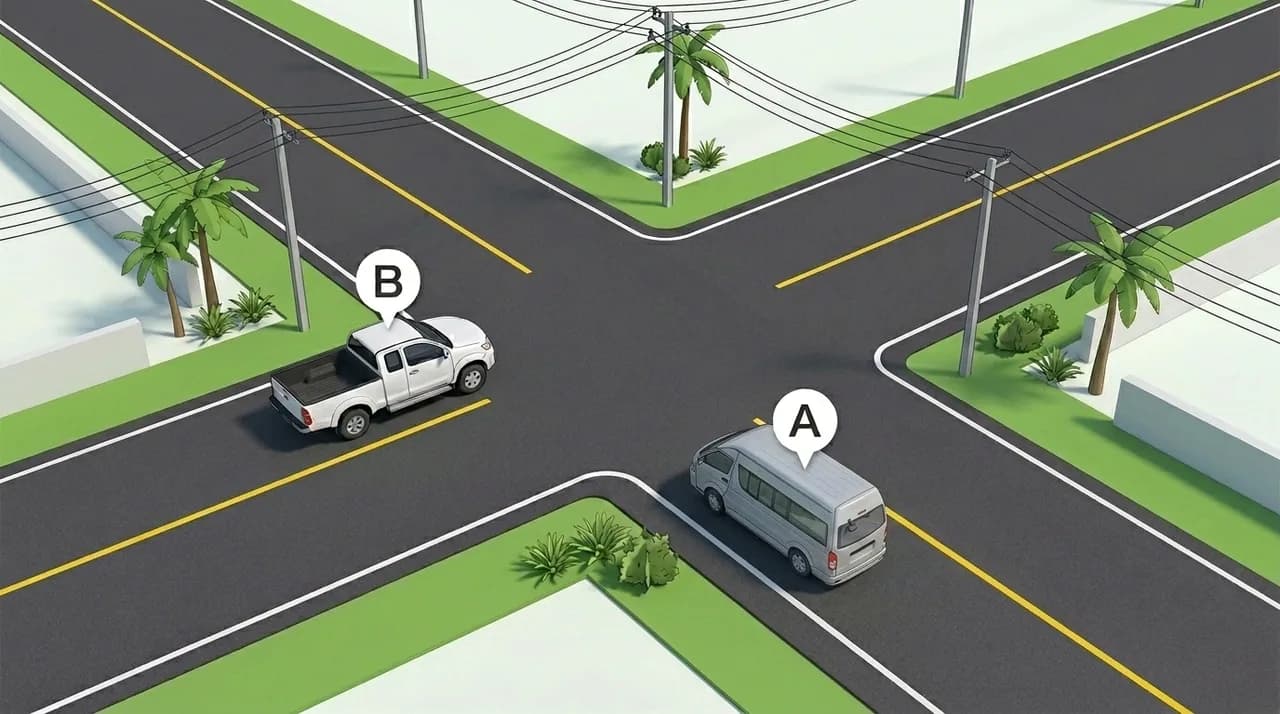
Car A and Car B reach an uncontrolled intersection at the same time. The roads are equal, and Car B is on Car A's left. Who should go first?
Show answer & explanation
Correct answer
A · Car B, the vehicle on Car A’s left.
When vehicles arrive at an uncontrolled intersection at the same time, Thai traffic law gives priority to the vehicle on the driver’s left. Therefore, Car A should let Car B go first. This rule applies only when the roads are otherwise equal; if one road is a main road and the other is a secondary road, traffic on the main road has priority.
Right of way
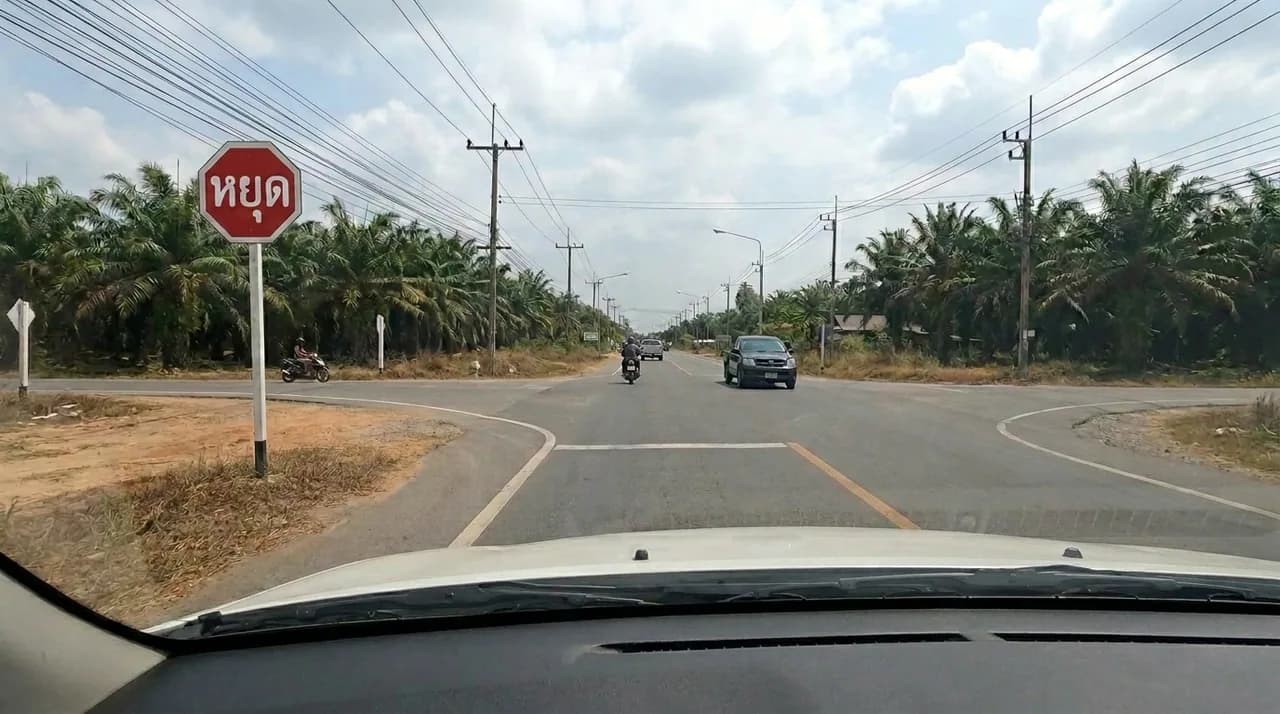
You are approaching an intersection with a STOP sign and a stop line across your lane. What must you do?
Show answer & explanation
Correct answer
A · Stop completely at or before the stop line, give way to traffic and pedestrians on the crossing road, and proceed only when it is safe.
A STOP sign requires a full stop at or before the stop line. You must stop every time, check for vehicles and pedestrians on the crossing road, and proceed only when the way is clear and safe.
Right of way
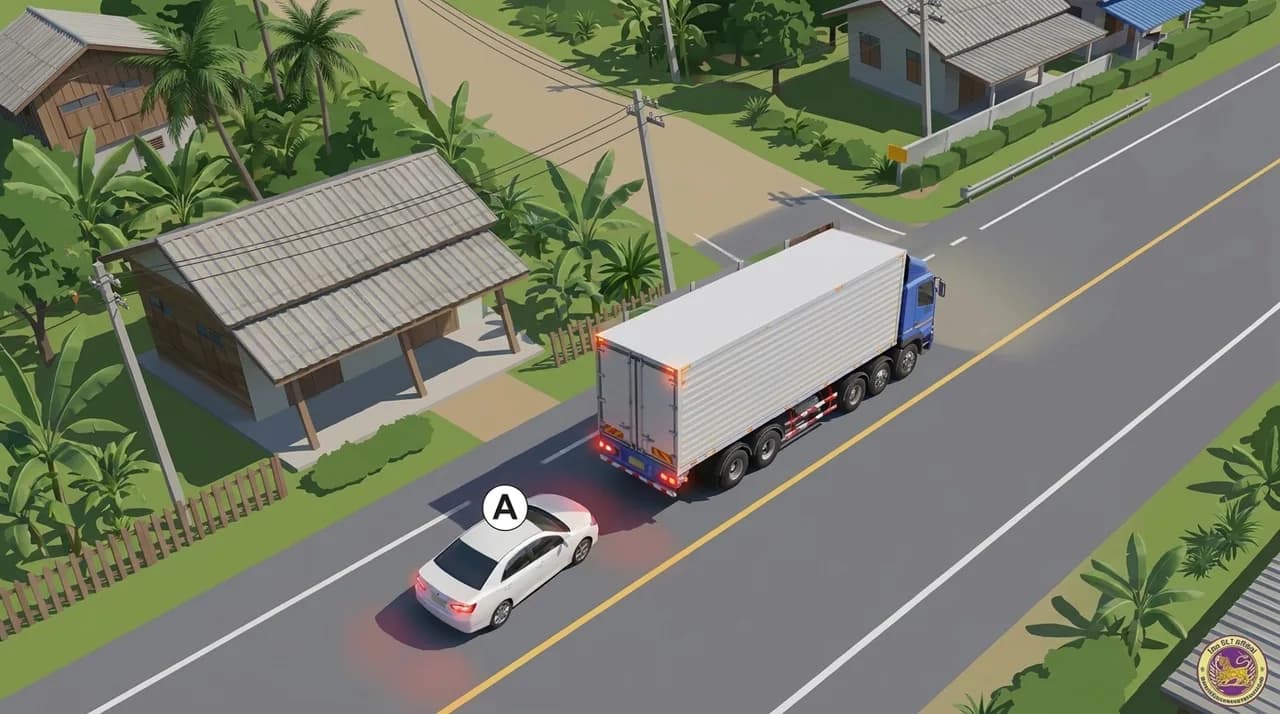
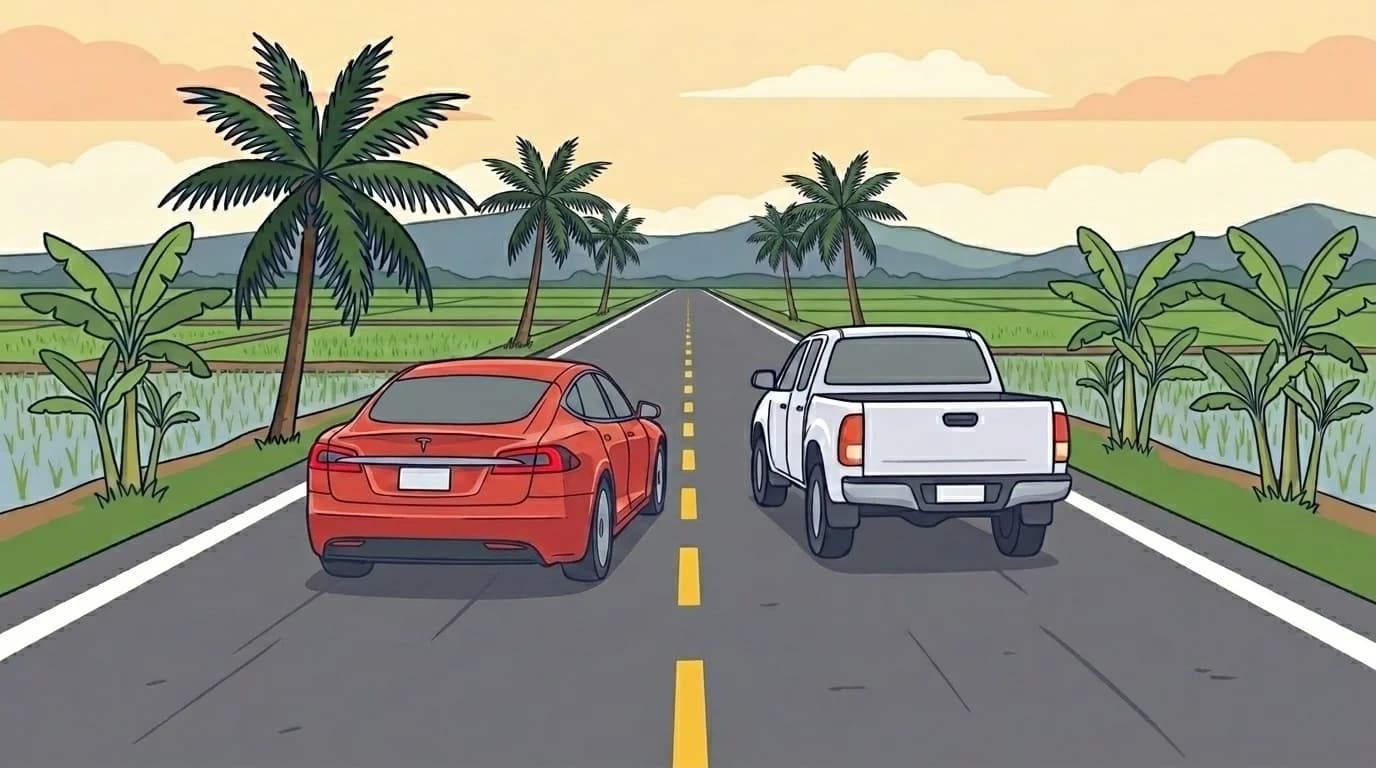
In the picture, Car A is following closely behind a large truck on a straight road. Why should its driver increase the following gap?
Show answer & explanation
Correct answer
A · To improve the view of hazards ahead and leave more room to stop
A large truck blocks the view of traffic and hazards ahead. Following too closely also leaves little time and distance to react if the truck brakes. A larger gap improves forward visibility, gives more stopping room, and helps the truck driver see Car A in the mirrors.
Right of way
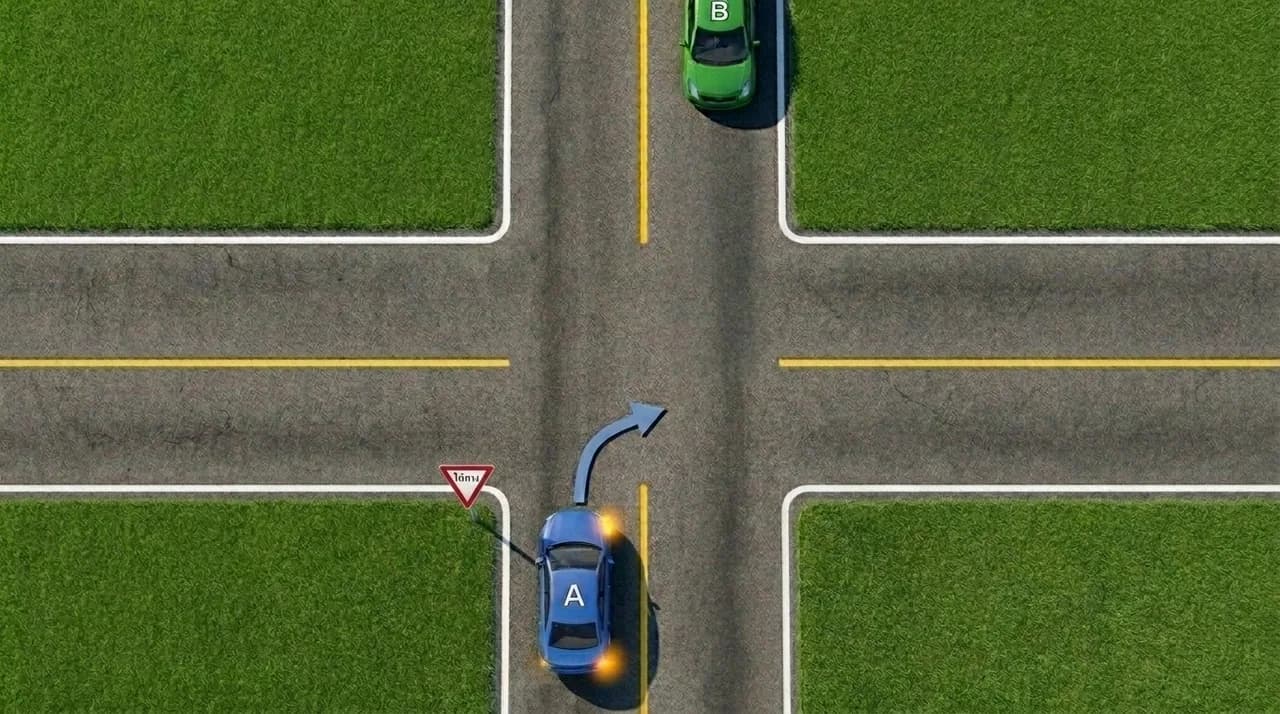
Car A is approaching an intersection and wants to turn right. Car B is coming straight from the opposite direction. What must Car A do?
Show answer & explanation
Correct answer
B · Stop and wait for Car B to pass before turning right.
Under Thai traffic rules, a driver turning right across oncoming traffic must give way to vehicles traveling straight ahead and must wait until it is safe to complete the turn. Arriving at the intersection first does not give the turning driver the right of way over oncoming traffic proceeding straight.
The free diagnostic checks ten questions across topics to spot weak areas.
Rule pattern
Already-in beats arriving.
The vehicle already on the priority road, already in the intersection, or already on the roundabout goes first. When two arrive together at an uncontrolled junction, the one on the left has priority. For an emergency vehicle using lights or a siren, stop or park safely on the left, but not inside the junction.
Junctions, roundabouts, merges, emergency vehicles. The patterns Thai exam wording uses to decide who goes first, untangled.
Written by a farang who failed once. Independent of the Thai Department of Land Transport. About FarangDrive.
FAQ
Common right of way questions
Real questions foreigners ask before the theory test. Practice content is based on common Thai driving-test topics and public guidance; it is not an official exam database.
Who has priority at an unsignalled junction in Thailand?
The vehicle already on the main road, or already inside the intersection, has priority. If two vehicles arrive together on equal roads, the left-side priority rule is the recurring exam pattern.What should I do for emergency vehicles?
When an emergency vehicle is using its siren or flashing lights, safely stop or park on the left and leave a clear path. Do not stop inside a junction, and do not try to overtake the emergency vehicle.Who yields at a roundabout?
Vehicles entering yield to vehicles already circulating in the roundabout. Follow local lane markings and signal before you exit.
Keep going
Related question topics
Now run them under pressure.
Try 5 samples here. The free 10-question diagnostic spots weak topics, then Practice helps you work on them.